What Is Local SEO and How Does It Work?
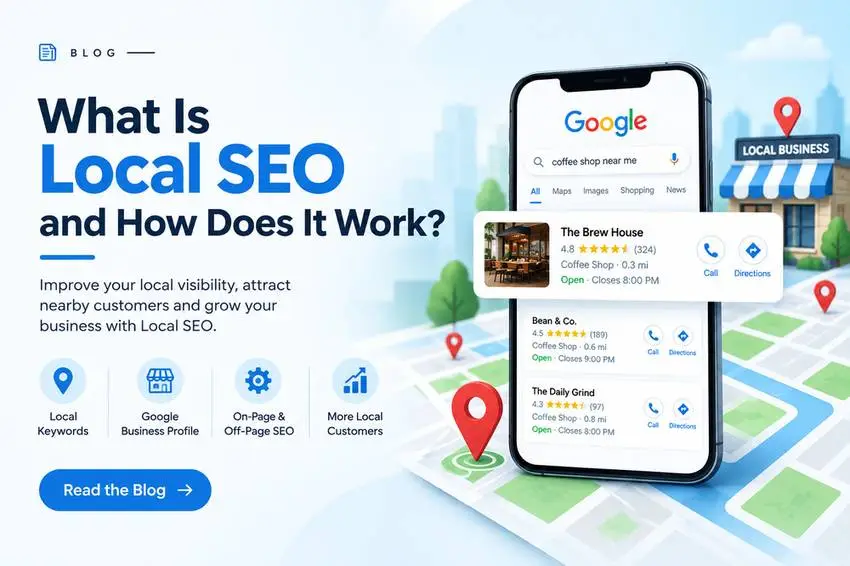
Local SEO is the process of improving a business’s visibility in search results for people looking for products or services in a specific area. It helps businesses appear when potential customers search for nearby services, local businesses, or terms that indicate a particular location.
For example, someone searching for “plumber in Banbury”, “Indian restaurant near me” or “website design agency Oxfordshire” has a clear local intent. Local SEO helps businesses become more visible for these searches across Google Search, Google Maps and other local search experiences.
For businesses that depend on customers in a particular town, city, region or service area, local SEO can be an important part of a wider SEO strategy.
What Is Local SEO?
Local SEO is a branch of search engine optimisation focused on improving a business’s visibility for geographically relevant searches.
Unlike general SEO, which can target users anywhere, local SEO focuses on searches where location matters.
A local search can include a location explicitly, such as:
- plumber in Banbury
- dentist in Oxford
- SEO agency in Oxfordshire
- web designer in Bicester
It can also be implicit, such as:
- plumber near me
- coffee shop near me
- emergency electrician
- Italian restaurant
Google uses several signals when determining which businesses should appear in local results. According to Google’s guidance on improving local rankings, local results are mainly influenced by relevance, distance and prominence.
This means local SEO is not simply about adding a town name to a website. It involves making sure Google can understand what a business offers, where it operates and why it should be considered relevant to a particular search.
Why Is Local SEO Important?
Local SEO can help businesses reach people who are actively searching for what they offer.
Consider a customer who searches for “emergency plumber near me”. They are not simply researching plumbing. They may need someone who can provide a service in their area.
Appearing prominently for that type of search can put a business in front of a potential customer at an important point in the buying journey.
Local SEO can help businesses:
- Increase visibility in local search results
- Appear in Google Maps
- Generate relevant website traffic
- Attract calls and enquiries
- Improve awareness in a local market
- Reach customers searching for specific services
- Build trust through reviews and business information
It also forms part of a broader search strategy. RizeWeb explains that SEO can help businesses improve online visibility, attract targeted organic traffic and reach specific audiences based on location and search behaviour.
How Does Local SEO Work?
Local SEO works by helping search engines understand three important things:
- What your business is relevant to
- Where your business operates
- How prominent and trusted your business is
Google refers to these core local ranking considerations as relevance, distance and prominence.
1. Relevance
Relevance means how closely a business matches what someone is searching for.
For example, if someone searches for “family solicitor in Oxford”, a solicitor offering family law services in Oxford is likely to be more relevant than a business offering unrelated legal services in another area.
Your website content, business category, services, Google Business Profile information and other online signals can help communicate relevance.
2. Distance
Distance considers how close a business is to the location associated with a search.
The location may come from the searcher’s location, the location included in their query or other available signals.
This is particularly important for businesses serving a defined geographical area.
3. Prominence
Prominence relates to how well known and established a business is.
Google states that prominence can be influenced by factors such as information about the business across the web, links and reviews.
This is why local SEO should not be treated as a single task. A strong local presence usually requires work across the website, Google Business Profile, reviews, citations, links and other online signals.
Where Do Local SEO Results Appear?
Local SEO can influence several areas of Google’s search experience.
Google Maps
Google Maps is particularly important for businesses with a physical location or defined service area.
A customer can search for a business category and location and then compare local businesses based on information such as their location, reviews, opening hours and other profile details.
Google Business Profile allows eligible businesses to manage how they appear across Google Search and Maps, including information such as their business hours, website, phone number, photos and customer reviews. Google’s Business Profile guidance explains how businesses can establish and manage their profile.
The Local Pack
The Local Pack, sometimes called the Map Pack, is the local business section that can appear within Google search results.
It can show several businesses alongside information such as their location, reviews, opening hours and other details.
For many local businesses, appearing in this section can generate valuable visibility because it places the business directly within a local search journey.
Local Organic Results
Local SEO also affects traditional organic search visibility.
For example, a search for “website design Banbury” may return local business websites in the standard organic results as well as businesses shown through Google’s local results.
This means businesses should not focus only on their Google Business Profile. Their website still needs strong content, useful service pages, good technical foundations and relevant authority.
What Are the Main Parts of Local SEO?
Local SEO involves several connected activities rather than one single optimisation technique.
Google Business Profile Optimisation
A complete and accurate Google Business Profile gives Google useful information about your business.
This can include:
- Business name
- Primary category
- Additional categories where appropriate
- Address
- Service areas
- Opening hours
- Website
- Phone number
- Services
- Photos
- Customer reviews
Businesses should follow Google’s guidelines rather than trying to manipulate their profile with unnecessary keywords.
Google specifically provides guidance for businesses on improving local rankings and managing Business Profiles. See Google’s local ranking guidance.
Local Keyword Research
Keyword research helps identify what potential customers search for when looking for your services.
A local keyword may contain a location:
SEO agency Banbury
Or it may imply local intent:
SEO agency near me
Good local keyword research should consider:
- Services
- Products
- Locations
- Search intent
- Customer terminology
- Service-area searches
- Long-tail queries
The goal is not to repeat location keywords unnaturally. It is to create useful pages that genuinely answer what people in the target area are looking for.
Website and On-Page SEO
Your website remains an important part of local SEO.
Important areas can include:
- Clear service pages
- Location-specific pages where genuinely useful
- Descriptive page titles
- Relevant headings
- Useful local content
- Internal linking
- Mobile usability
- Fast page performance
- Clear contact information
- Strong calls to action
A well-designed website can also make it easier for visitors to understand your services and take the next step. RizeWeb provides website design services focused on creating websites that communicate value clearly and support business goals.
Reviews and Reputation
Reviews can influence how customers perceive a business and are also relevant to local search prominence.
Businesses should focus on generating genuine customer feedback rather than trying to manipulate review signals.
Google allows businesses to ask customers for reviews and provides guidance on how to do this appropriately. Google’s review guidance explains how businesses can request reviews from customers.
Avoid buying reviews, creating fake reviews or offering incentives in exchange for positive feedback.
A better approach is to consistently provide a good customer experience and make it easy for genuine customers to leave feedback.
Local Citations
Local citations are mentions of a business’s details on websites such as directories, industry websites and other relevant platforms.
They may contain information such as:
- Business name
- Address
- Phone number
- Website
Consistency matters because conflicting business information can make it harder for users and search engines to understand which information is correct.
However, local businesses should prioritise relevant and trustworthy directories rather than creating large numbers of low-quality listings simply for the sake of having more citations.
Local Links
Links from relevant websites can help establish a business’s authority and local relevance.
Potential sources include:
- Local organisations
- Industry associations
- Chambers of commerce
- Local publications
- Community organisations
- Business partners
- Relevant local websites
The focus should be on earning useful, relevant links rather than collecting links from unrelated websites.
Technical SEO
Technical SEO supports local visibility by ensuring that search engines can efficiently crawl, understand and access your website.
Important areas include:
- Mobile usability
- Page speed
- Indexability
- Internal linking
- HTTPS
- Canonicalisation
- XML sitemaps
- Structured data
RizeWeb website development services also emphasise SEO-friendly architecture, performance and responsive websites, which can provide a strong technical foundation for search visibility.
LocalBusiness Structured Data
Structured data can help search engines understand important information about a local business.
Google’s LocalBusiness structured data documentation explains how businesses can provide information such as business details and opening hours using structured data.
Structured data should be accurate and reflect information that is actually present on the page. It can help search engines understand content, but implementing structured data does not guarantee higher rankings.
Who Needs Local SEO?
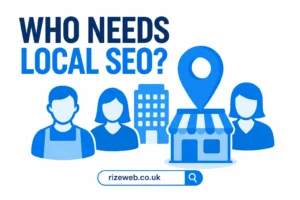
Local SEO can benefit many types of businesses that serve customers in specific geographical areas.
Examples include:
- Plumbers
- Electricians
- Builders
- Solicitors
- Accountants
- Dentists
- Doctors and clinics
- Restaurants
- Hotels
- Gyms
- Beauty salons
- Estate agents
- Cleaning companies
- Car garages
- Tradespeople
- Professional service providers
- Local shops
- Marketing agencies
- Web design agencies
It can also be valuable for businesses that operate across several towns or regions.
However, the strategy should reflect how the business actually operates rather than creating pages for locations where the business does not provide services.
What Is Local SEO for Service-Area Businesses?
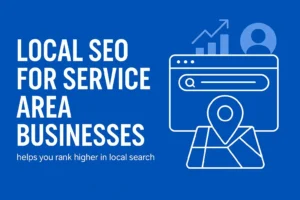
Not every local business has a shop or office where customers visit.
Examples include plumbers, cleaners, electricians, landscapers and mobile repair services.
These businesses may operate within a defined service area instead of serving customers at a physical address.
Google provides specific guidance for service-area and hybrid businesses. Businesses can specify the areas they serve, including cities, postcodes and other defined areas.
This makes service-area businesses an important part of local SEO.
For example, a plumber based in Banbury might serve Banbury, Bicester and surrounding areas. Their local SEO strategy can reflect the locations and services they genuinely cover.
The key is accuracy. Location pages should not simply be created to target every town imaginable. Each page should provide genuine value and accurately represent the business’s service coverage.
Local SEO vs Traditional SEO
Local SEO and traditional SEO share many fundamentals, but the focus is different.
| Traditional SEO | Local SEO |
| Can target national or global audiences | Focuses on specific geographical areas |
| Often targets broader search terms | Targets local and location-based searches |
| Focuses heavily on organic rankings | Includes organic and local search visibility |
| Content and backlinks are important | Content, backlinks, reviews, citations and business information can all matter |
| Location may not be important | Location is often central to search intent |
The two strategies can also work together.
For example, a local business may need strong technical SEO, useful content and authoritative links while also optimising its Google Business Profile and local presence.
RizeWeb’s SEO services cover broader search visibility, ongoing optimisation and SEO performance monitoring, making local SEO a natural component of a wider search strategy.
How to Get Started With Local SEO
If your business has not invested in local SEO before, start with the fundamentals.
Step 1: Review Your Google Business Profile
Make sure your business information is complete, accurate and consistent.
Check:
- Business name
- Category
- Address or service area
- Phone number
- Website
- Opening hours
- Services
- Photos
- Reviews
Step 2: Research Local Searches
Find out what customers actually search for.
Start with your main services and combine them with relevant locations where appropriate.
For example:
service + town
service + city
service + near me
specific service + location
Do not assume that every location keyword deserves a separate page.
Step 3: Improve Your Important Pages
Make sure your core service pages clearly explain:
- What you offer
- Who you help
- Where you operate
- Why customers should choose you
- How customers can contact you
Avoid producing thin pages that simply swap one town name for another.
Step 4: Build Local Authority
Look for legitimate opportunities to earn relevant mentions and links.
You can also ensure that important business directories contain accurate information.
Step 5: Encourage Genuine Reviews
Ask satisfied customers for honest reviews and respond professionally to feedback.
Reviews should reflect real customer experiences.
Step 6: Monitor Results
Track more than just one keyword.
Useful metrics can include:
- Organic traffic
- Local search visibility
- Google Business Profile interactions
- Calls
- Website enquiries
- Direction requests
- Relevant keyword performance
- Leads and conversions
RizeWeb also highlights ongoing SEO audits and performance reporting as part of its approach to monitoring search performance.
Common Local SEO Mistakes to Avoid
Local businesses often make avoidable mistakes when trying to improve search visibility.
Creating Fake Location Pages
Creating dozens of pages for towns where you do not operate can create thin or misleading content.
Only create location pages when there is a genuine business reason and useful information to provide.
Keyword Stuffing
Repeating phrases such as “best plumber Banbury plumber Banbury plumber” does not create a better experience.
Use location and service terms naturally.
Ignoring Reviews
A Google Business Profile with incomplete information and little customer feedback may provide less value to potential customers than a profile that is actively maintained.
Inconsistent Business Information
Different names, addresses or phone numbers across important online listings can create confusion.
Keep your core business information accurate.
Buying Fake Reviews or Links
Manipulative tactics may create short-term activity but can damage trust and potentially lead to penalties or restrictions.
Local SEO should be based on genuine business information, useful content and legitimate authority.
Treating Google Business Profile as the Whole Strategy
A Business Profile is important, but local SEO does not stop there.
Your website, content, technical SEO, reviews, citations, links and overall online presence can all contribute to a stronger local search strategy.
How Long Does Local SEO Take?
There is no universal timeframe for local SEO.
The time required to see meaningful improvements can depend on factors such as:
- Website age
- Existing authority
- Competition
- Business location
- Search demand
- Website quality
- Google Business Profile quality
- Review profile
- Existing citations
- Local links
- Technical issues
- Content quality
Some improvements can happen relatively quickly after fixing incorrect business information or improving important pages. Competitive local searches can take considerably longer.
RizeWeb similarly notes that SEO results typically begin to show over a period of months and depend on factors such as website size, structure and existing performance.
The important point is to treat local SEO as an ongoing process rather than a one-time task.
Is Local SEO Worth It?
For businesses that depend on customers in specific locations, local SEO can be highly valuable.
Someone searching for a local service is often much closer to taking action than someone conducting a broad informational search.
For example, a person searching for “emergency electrician near me” has a very different intent from someone searching for “what does an electrician do?”
Local SEO helps businesses connect with the first type of searcher when they are actively looking for a relevant service.
The strongest approach is not simply trying to rank for more local keywords. It is about creating an accurate, useful and trustworthy online presence that helps both search engines and customers understand the business.
Final Thoughts
Local SEO is the process of improving a business’s visibility for relevant searches connected to a particular location.
It involves much more than adding a town name to a website.
A strong local SEO strategy can include Google Business Profile optimisation, local keyword research, useful service and location content, reviews, citations, local links, technical SEO and structured data.
Google’s local search system considers factors including relevance, distance and prominence, so businesses should focus on providing accurate information and building genuine authority rather than relying on shortcuts.
For businesses that want to strengthen their search visibility, RizeWeb provides SEO services alongside digital marketing services designed to support broader online growth.
You can also explore RizeWeb’s SEO and digital marketing insights for related guidance on improving online visibility.